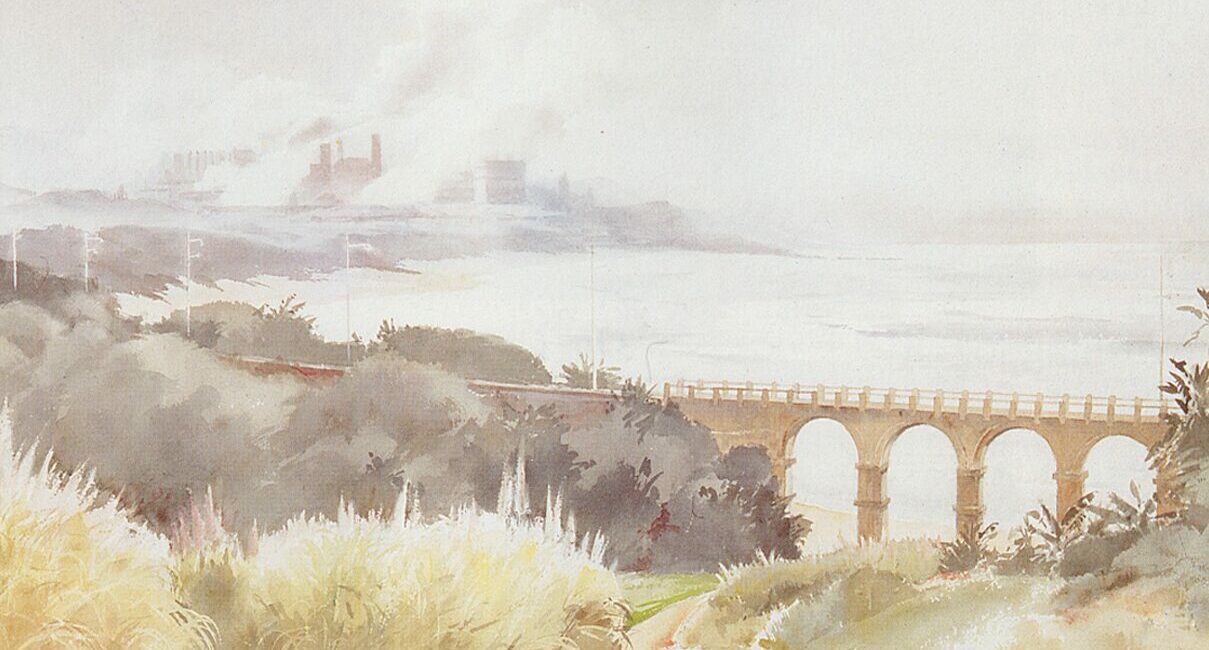
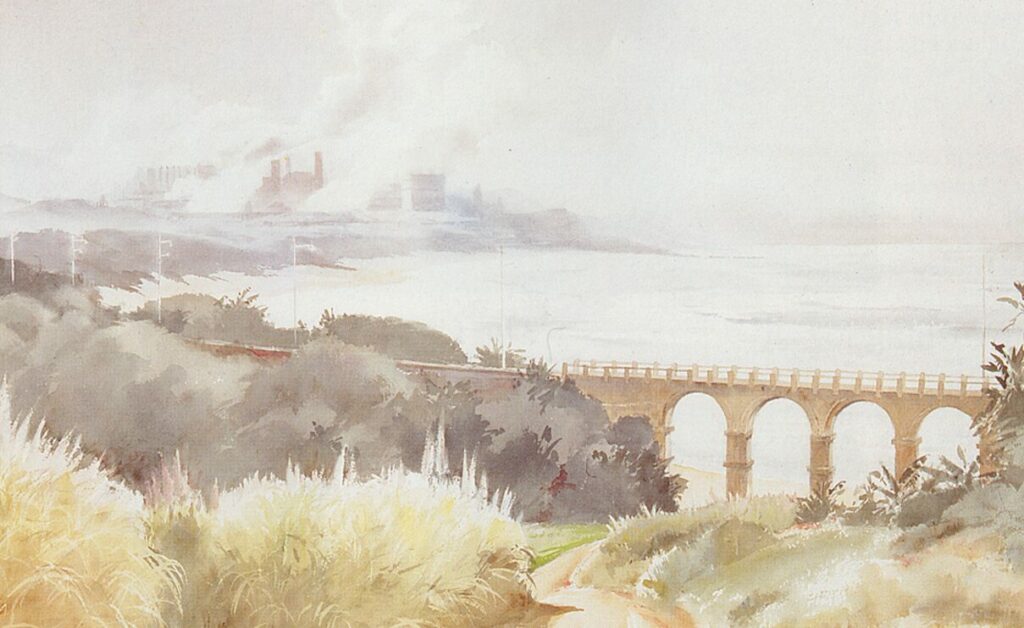
An exquisite contemporary watercolour from well listed artist Rowena Elizabeth Bush. Title is Sezela in 1990. Scanned from the publication C G Smith – Sugar, One Hundred Years, publish by the Group in 1991
Bazley is bounded by the Ifafa and Ndasingane Rivers, and to the north is the Sezela River, reaching the sea on the south side of the sugar mill.
The Ifafa River gets its name from the sound it makes as it tumbles over the rocks, in the gorges near Ixopo where the headwaters are. Early in the 1860’s, Charles Hamilton travelled down the coast and like many other Victorians who recorded their journeys, had something to say about Nil Desperandum, the Bazley farm, on the banks of the Ifafa. He travelled up the Ifafa River in a punt hollowed out from a log and he marveled at the abundant wildlife. He saw leopard, hippos, stalks, ipiti, blesbok, monkeys, snakes and crocodiles. He found the wild honey splendid and considered the butterflies and moths more varied than Brazil’s.
The Ndasingane River is the northern boundary of Bazley, and takes its name from a herb that grows on its banks, much sought after by herbalists. The historian T V Bulpin spelt the name “Ndesingane”, though the Bazley family have always known it as “Mdesingane.”
The Sezela River has an interesting history. Originally known as the Malangeni River, after the tribe living on its banks, its name was changed by Shaka Zulu. A large crocodile, renowned for its man-eating tendencies brought the river into ill-repute. Like a diviner, the crocodile was said to have the ability to smell out its victims. Legend has it that Shaka and his army were once bivouacked by this river and several warriors were lost to the crocodile. Shaka decided he wanted the crocodile’s skin, it was hunted down and killed. iSezela “the One Who Smells Out” lingered on as a memory of the past.
The Sezela River has an interesting lagoon. It is very deep, having never silted up like most of our coastal rivers where the railway bridges have trapped silt. The dam built upstream to supply the sugar mill, served to trap silt flowing downstream. Deep hippo runs between the reeds are evident to this day and the fish stocks, otters and fish eagles are abundant.
For a deeper exploration of Bazley’s rich history, you can acquire the book “Nil Desperandum: The Bazley Story” written by Denzil Bazley. To learn more and obtain a copy, please reach out to him via email at bazley@mweb.co.za