Shaka’s Influence: The Legacy of Conflict in Bazley
While the Bazley area has seen little conflict in recorded history, there are some interesting stories to tell. Shaka moved through the area several times during the 1820s, on his military campaigns to the south, against the Pondos and the Xhosa. On one such journey, he renamed the Malangeni River after the man-eating crocodile that had attacked his warriors, naming it “Sezela” for its ability to sniff out its prey. Shaka also cleared the area of its original inhabitants, some turning to cannibalism to survive. As a result, the area around Bazley was largely unoccupied when the settlers arrived in the 1850s, and there were still cannibals in the Umtwalume area until 1864.
Settler Fortifications: Defending Against Zulu Threats
During the 1860s and 70s, the Zulus posed a real threat in the minds of settlers in the area, and homes like Lynton Hall at Umdoni were built to be defended, with water storage tanks and battlements. Bazley is situated in what was known as Alexander County; Natal was then divided into areas known as counties. Umzinto was the economic and cultural hub of Alexander, and the headquarters of the Alexander Mounted Rifles, later amalgamated into the Natal Mounted Rifles, now based adjacent to the Durban Country Club.
The Bazley Military Legacy: From Norwegian Wanderer to Colonial Commandant
The first Sergeant-major was an enigmatic Norwegian by the name of H T Bru de Wold, who in 1862 had jumped overboard from a Norwegian naval ship anchored off Durban, after an argument with the captain. He wandered down the coast and found work and the hospitality of the Bazley family, at the farm Nil Desperandum on the Ifafa River. Most especially, he became enamoured with Sarah Bazley whom he married in 1871.
From Zulu Wars to World Wars: Bazley’s Role in Global Conflicts
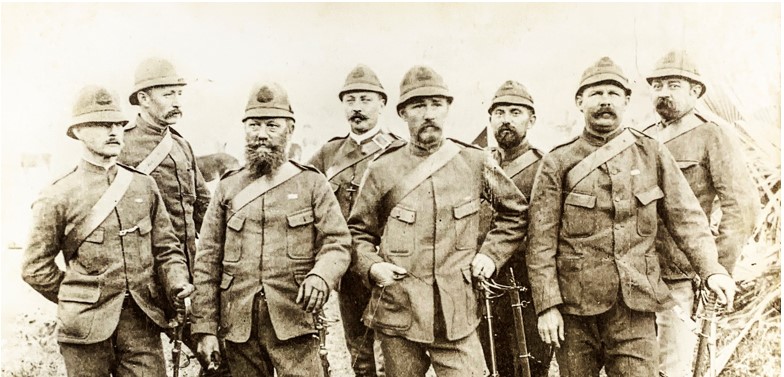
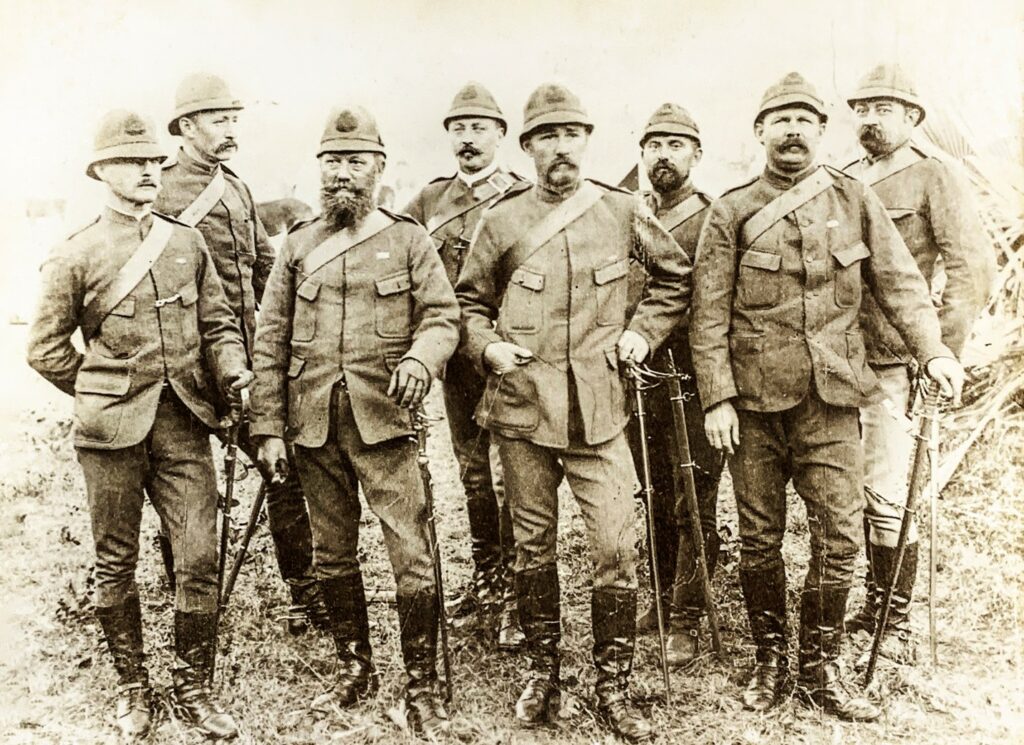
Two young Bazleys, George and Harry, also joined the A.M.R. along with many well-known South Coast names; four Arbuthnots, Archibald, Crocker, two Penningtons, two Reynolds, two Shooters, and others from the area. Their first action was in the Zulu War of 1879, where they served as scouts and support to the British military offensive against King Cetshwayo, including the Battles of Ulundi and Eshowe.
Honoring Sacrifice: Bazley’s Contribution to World War I
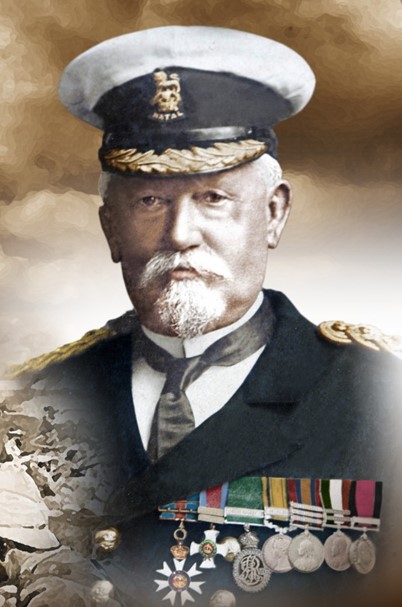
When the Anglo Boer War commenced in 1899 Bru de Wold had reached the rank of Major and was Officer Commanding of the A.M.R. Unfortunately, the unit was trapped at Ladysmith and endured 16 weeks under Boer rifle and cannon fire, fortunately all surviving. BdW was badly wounded but survived and was promoted to Colonel, becoming the Officer Commanding of the Natal Mounted Rifles, an amalgamation of several smaller mounted rifle units. The unit went on to see more action in the Boer War. Bru de Wold once again saw action as Commandant of the Colonial Forces during the 1906 Bambatha Rebellion.
Continuity of Service: Bazley’s Contribution to World War II
Sadly, several Bazley men died in the First World War, including the only sons of H T Bru de Wold and Edward Bazley, whose Woolwich farmhouse was at the corner of Ridge and Hilltop Roads. Also lost was Arthur Royle Payne whose sister Amy, grandmother of Denzil and Garnett Bazley, lived at Kingsdale (opposite the abandoned factory). It is ironic that despite the military escapades in South Africa, all the Bazley men ever to make the supreme sacrifice were lost in actions in France, at Delville Wood and other battles of the Somme in 1916. It was a terrible price for a family to pay.
Beyond Borders: Bazley’s Connection to the South African Border War
Several Bazley men born at Kingsdale served in World War Two, in North Africa and Italy, including Roy, father of Denzil and Garnett Bazley. There are several older men at Bazley who served in the SADF during the Border War of 1966 to 1990, carrying on the proud tradition of South African soldiery. Ply them with beer and you’re sure to hear some stories of military life on the Border!
For a deeper exploration of Bazley’s rich history, you can acquire the book “Nil Desperandum: The Bazley Story” written by Denzil Bazley. To learn more and obtain a copy, please reach out to him via email at bazley@mweb.co.za