

Wildlife of Bazley: The Elusive Genet
One of Bazley’s most fascinating nocturnal residents is the genet. Although many homeowners have caught a glimpse of one darting across a deck or moving gracefully through the trees at night, these shy and secretive mammals are seldom seen during daylight hours.
The species found in Bazley is the South African Large Spotted Genet which is one of four species of Genet that occur in southern Africa. It has a limited distribution and only occurs on the coastal belt of KZN and the Eastern and Western Cape. Excellent climbers and highly agile, genets spend much of their time moving through trees and dense vegetation in search of food.
Despite their cat-like appearance, genets are not cats. They belong to a separate family of mammals and are more closely related to civets. They are solitary animals, spending most of their lives alone except during the breeding season.
Nature’s pest controllers
Genets play an important role in maintaining a healthy ecosystem. They are opportunistic hunters and feed on a wide variety of prey, including rodents, insects, lizards, frogs and even small snakes. By helping to control rodent populations naturally, they provide an important ecological service to both natural areas and residential properties.
They are also known to eat fruit and occasionally assist with seed dispersal, contributing to the health and regeneration of indigenous vegetation.
Perfectly adapted to life in Bazley
The combination of coastal forest, gardens, open spaces and abundant wildlife makes Bazley an ideal habitat for genets. Their large eyes provide excellent night vision, while their keen sense of smell and hearing help them navigate and hunt in darkness.
Although they are generally harmless to people, they can become vulnerable when natural habitat is lost or fragmented. Domestic dogs may also pose a threat to genets, particularly young animals.
Why they are worth protecting
Genets are an important part of Bazley’s biodiversity and serve as indicators of a healthy environment. The presence of these beautiful creatures suggests that our coastal ecosystem continues to support a rich variety of wildlife.
As residents, we can help protect genets by preserving indigenous vegetation, driving carefully at night, avoiding the use of poisons that can affect the food chain, and ensuring that pets do not harass wildlife.
The next time you spot a pair of bright eyes reflected in your torchlight or security lights, take a moment to appreciate one of Bazley’s most elegant and beneficial nocturnal visitors.
Protecting wildlife such as the genet helps preserve the natural character that makes Bazley such a special place to call home.
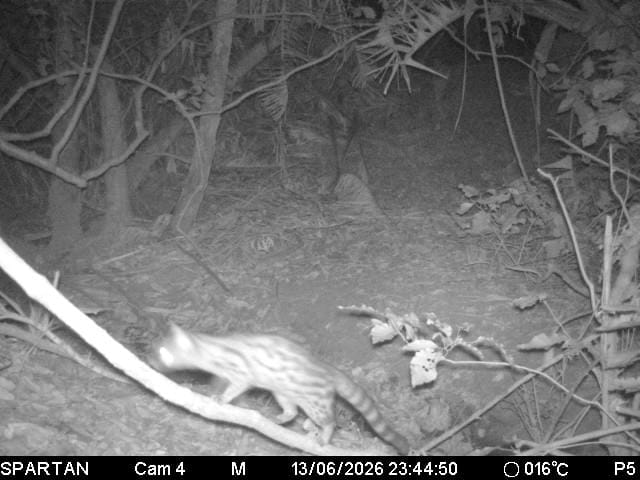
A resident Large-spotted Genet captured on one of Bazley’s trail cameras. Although seldom seen during the day, these elusive nocturnal mammals are regular visitors to our coastal forests and gardens.
🐾 Did You Know?
- Genets are excellent climbers and spend much of their time in trees.
- They are not cats, despite looking like one.
- A genet’s diet includes rodents, insects, frogs, lizards and small snakes.
- They help control pest populations naturally.
- Their presence is a sign of a healthy ecosystem.
- They are mostly active between dusk and dawn.