Submission on the 2nd draft of the DBAR, dated July 2024, as prepared by EnviroPro 23 August 2024
The BRA is a representative body for the town of Bazley, and is registered as an IAP for the Project.
This second submission serves as a supplement to our original submission dated 30 June 2024. It should also be read in conjunction with the subsequent email correspondence between the BRA and Enviropro following 30 June 2024.
1. Acknowledgement of DBAR review
We received the second draft of the DBAR on 24/7/2024, for review and comment. We acknowledge that the concerns, queries and suggestions in our submission were considered and addressed, as detailed in App C7, Comments & Responses Table (the CART).
We wish to highlight the following key issues:
2. Feedback from consulting engineers
From the outset of the public participation process the engineers have maintained that there is only one correct route and that no alternative routes are feasible. However, two deviations we proposed in our original submission, covering two thirds of the route, have now been accepted. While we are satisfied with this amendment, at the same time it indicates that deviations are possible, where the outcome merits it. We are concerned that the engineers are ignoring the physical realities of Bazley and dismissive of constructive suggestions from directly affected parties.
Upon receiving the second DBAR, the deadline for submissions by IAPs was set for 23 August 2024. We submitted questions to Enviropro on 5 August 2024 but only received responses on 16 August 2024, 11 days later. Enviropro attributed this delay to the engineers, who also took 17 days to respond during the first comment period. Both delays are unreasonable, given the tight deadlines imposed on us – 28 of 60 days spent waiting for answers to questions that were critical to our proper understanding of the technical aspects of the Project.
In an email dated 20 August 2024, we formally expressed our dissatisfaction with the engineers’ conduct during this process. While the full email is presumably available elsewhere in the documentation, we concluded that “the engineers have communicated ineffectively, provided inadequate information, and have been slow to respond—particularly problematic in a time-sensitive process. When a more detailed response was finally provided, it was written in terms both arrogant and patronizing, containing veiled accusatory language, which we find both unprofessional and unacceptable.”
As has been stated previously, our submissions related solely to Bazley and its environs. We are however acutely aware of the imperative for this project to urgently provide effective water services to the Greater Malangeni and GDP communities. The implication by the engineers that our inputs into the public participation process are somehow delaying the provision of water to our neighbours is fallacious and deeply resented.
3. Concerns about Ugu Municipality’s credibility
Our primary concern remains ensuring that the Project, as it pertains to Bazley and the Bazley Conservancy, is executed competently, is properly managed, and independently monitored, with the necessary safeguards and oversight in place, and that ultimately, negative impacts are avoided or minimised, and appropriately mitigated as far as possible. This will not take place under Ugu’s supervision.
The CART clearly shows that many IAPs share our concerns. As one IAP noted, “Experience has proved that Ugu is incapable of undertaking a project or development in an environmentally sensitive manner. They have a ‘gung-ho’ attitude and show total disregard for applicable legislation. Moreover, this municipality lacks the official and political commitment to rehabilitate or reinstate affected areas.”
In point 4 of our original submission, for incorporation into the first DBAR, we detailed the illegal clearing between the Sezela and Ndesingane Rivers undertaken by Ugu and noted that, despite explicit DBAR requirements, no rehabilitation had occurred after seven months. It has now been nine months without action, further proving that “this municipality lacks the official and political commitment to undertake any rehabilitation or reinstatement of the areas on which they impact.”
The responses in the CART from the consultants suggest that we should rely on the mitigation and monitoring measures outlined in the Environmental Management Programme (EMPr). Though these measures may appear on paper to be comprehensive, past experience has shown us that Ugu cannot be trusted to comply with environmental (and other) legislation, and acts with impunity. Therefore, we take no comfort in these mitigation measures and are doubtful that the measures will be implemented and enforced.
4. Suggested route variation
Our point 12.c (pg. 83/4) in the CART, the response thereto and the engineers’ further response in an email from Enviropro dated 16 August 2024 refer. We do not believe that the points raised by the engineers preclude consideration of our suggested pipeline route deviation for the following reasons:
- Regarding the engineers’ statement that “the large deviation around the town of Bazley cannot be considered in the application. The key reason for this is that the project involves bulk augmentation pipelines that will connect to existing supply reservoirs and smaller active reticulation network pipes as needed… The existing deteriorating old bulk pipeline will remain in the ground, with re-connections made to the new bulk pipeline at suitable locations… Relocating the replacement line to a different location would make this process unfeasible”:
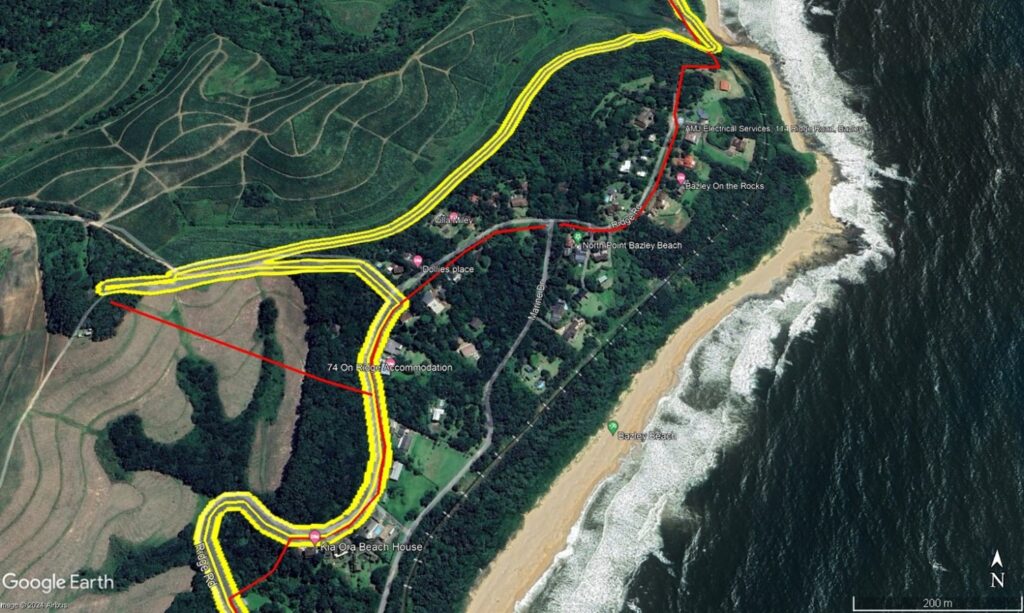
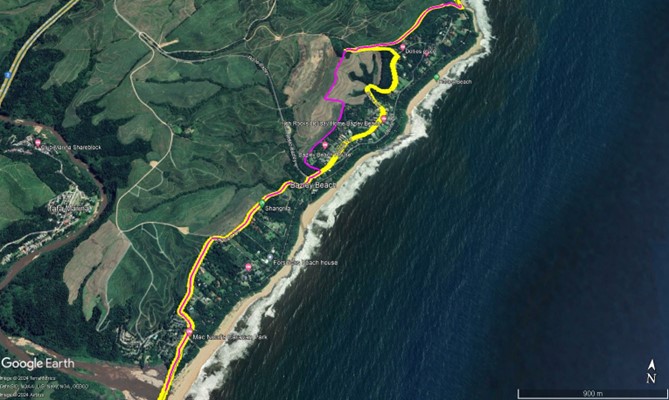
- The attached map (Annexure 1) indicates the existing pipeline in red (KMZ file provided by Enviropro) and the proposed pipeline in yellow (KMZ file provided by Enviropro). It clearly shows significant deviations in the proposed pipeline compared to the existing pipeline, particularly:
- The proposed pipeline does not follow nearly 1 km of the existing pipeline on Ridge Rd, from Reservoir Rd to Ndesingane.
- Another significant portion of the existing pipeline crosses the sugarcane fields from Ridge Rd to the reservoir, while the proposed pipeline bypasses this route and continues up Ridge Rd before turning up Reservoir Rd to the reservoir.
- These deviations contradict the engineers’ assertion that “relocating the replacement line to a different location would make this process unfeasible,” as they themselves have already proposed such deviations, and have already accepted two other deviations proposed by us.
- The attached map (Annexure 1) indicates the existing pipeline in red (KMZ file provided by Enviropro) and the proposed pipeline in yellow (KMZ file provided by Enviropro). It clearly shows significant deviations in the proposed pipeline compared to the existing pipeline, particularly:
- Regarding the claim that our proposed route would result in “unnecessary expenditure”:
- Our proposed route (from the corner of Bushbuck Way to the reservoir) is approximately 1.3 km long, while the proposed route is about 1.8 km, 40% longer. Additionally, our suggested route avoids trenching through:
- Three roads (Ridge, Bushbuck, and Hilltop);
- Twenty-four driveways;
- Eight meter boxes (on the roadside); and
- Two waterways (WC28/WC29).
- Intuitively, our suggested route would be significantly more cost-effective than the proposed route, so we do not accept the engineers’ assertion that it would result in “unnecessary expenditure.”
- Further, the engineers contend that a whole gamut of specialist assessments will need to be completely redone, requiring substantial additional cost and time, however, this seems unlikely for the specialist fields that they list, given the absence of aquatic/freshwater systems, the absence of estuaries, and the highly transformed and previously excavated nature of the proposed route, which would not require further detailed vegetation, palaeontological and heritage assessments.
- Our proposed route (from the corner of Bushbuck Way to the reservoir) is approximately 1.3 km long, while the proposed route is about 1.8 km, 40% longer. Additionally, our suggested route avoids trenching through:
- The engineers have provided the following set of rules (italics) that they follow for determining a route. We have provided our responses (bold) to this approach:
1.. The correct route for secondary bulk pipeline replacements as a rule is;
- ‘From one bulk storage/off-take point to the next bulk storage/off-take point.’ Both routes meet this requirement.
- ‘Follow an existing servitude if there is for that purpose, and/or a road, unless there is valid exceptional reason to deviate somewhere else.’ Our proposed route follows an existing road network and road servitude, so this is not problematic. Further, we consider the substantial disruptions we’ve described to a major part of the town’s road system and many residential properties, and the reduced impacts described above if our proposed route was used, to qualify as ‘a valid exceptional reason’.
- ‘For any exceptional deviation avoid at all costs engaging any private properties.’ The route put forward by the engineers will engage Illovo and many private residential landowners and businesses. The alternative route we have suggested would also engage Illovo but no private residential landowners and businesses, thus making our proposed route far less problematic according to this rule.
- ‘For any exceptional deviation avoid any new green-field implications rather than existing route’ While we are not entirely sure of the engineers’ definition of ‘green-field implications’, we believe our proposed route avoids any green-field implications, as it follows an existing road system for its virtual entirety, and runs through highly transformed areas (road verge and sugarcane fields) for the entirety of its route.
5. Recommendations
- Approve the route proposed by us as detailed in our original submission, discussed above and detailed in Annexure 2.
- Provide us (BRA) with copies of the ECO audit reports.
- Authorise a member of BRA to consult with the ECO on the progress of the Project through Bazley.
- Where areas of forest have to be cleared, follow the rehabilitation suggestions detailed in Annexure 3.
Annexure 1
Proposed pipeline route (yellow) vs existing pipeline (red)
Annexure 2
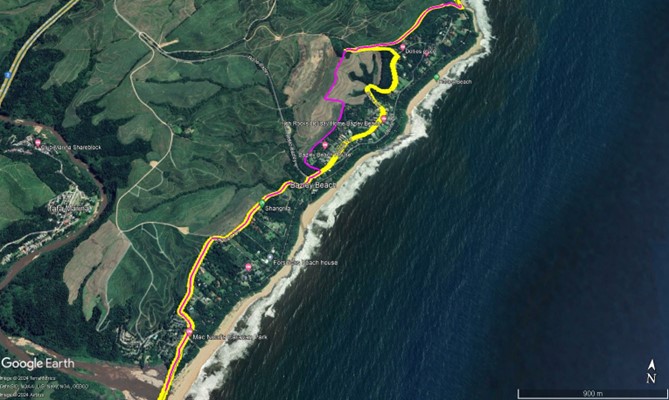
Proposed pipeline route (yellow) vs suggested BRA pipeline route (pink)
Annexure 3
Rehabilitation of forest areas
If it is required that areas within the Bazley section require planting as part of rehabilitation of forest, it is recommended that the species used are drawn primarily from the following list, based on knowledge of local forest vegetation.
Larger trees
- Syzygium cordatum
- Ficus sur
- Apodytes dimidiata
- Bridelia micrantha
- Harpephyllum caffrum
- Protorhus longifolia
- Searsia chirindensis
- Croton sylvaticus
- Trema orientalis
- Psydrax obovata
- Sideroxylon inerme
Understory/small trees
- Allophylus dregeanus
- Allophylus natalensis
- Psychotria capensis
- Tabernaemontana ventricosa
- Deinbollia oblongifolia
- Pavetta revoluta
- Bersama lucens
- Grewia occidentalis
- Dracaena aletriformis